Showing posts with label LIfe Skills. Show all posts

Thursday, June 15, 2017

The Goals of Our Children's Program


This picture shows some of the benefits your kids will develop through their martial arts training with us.
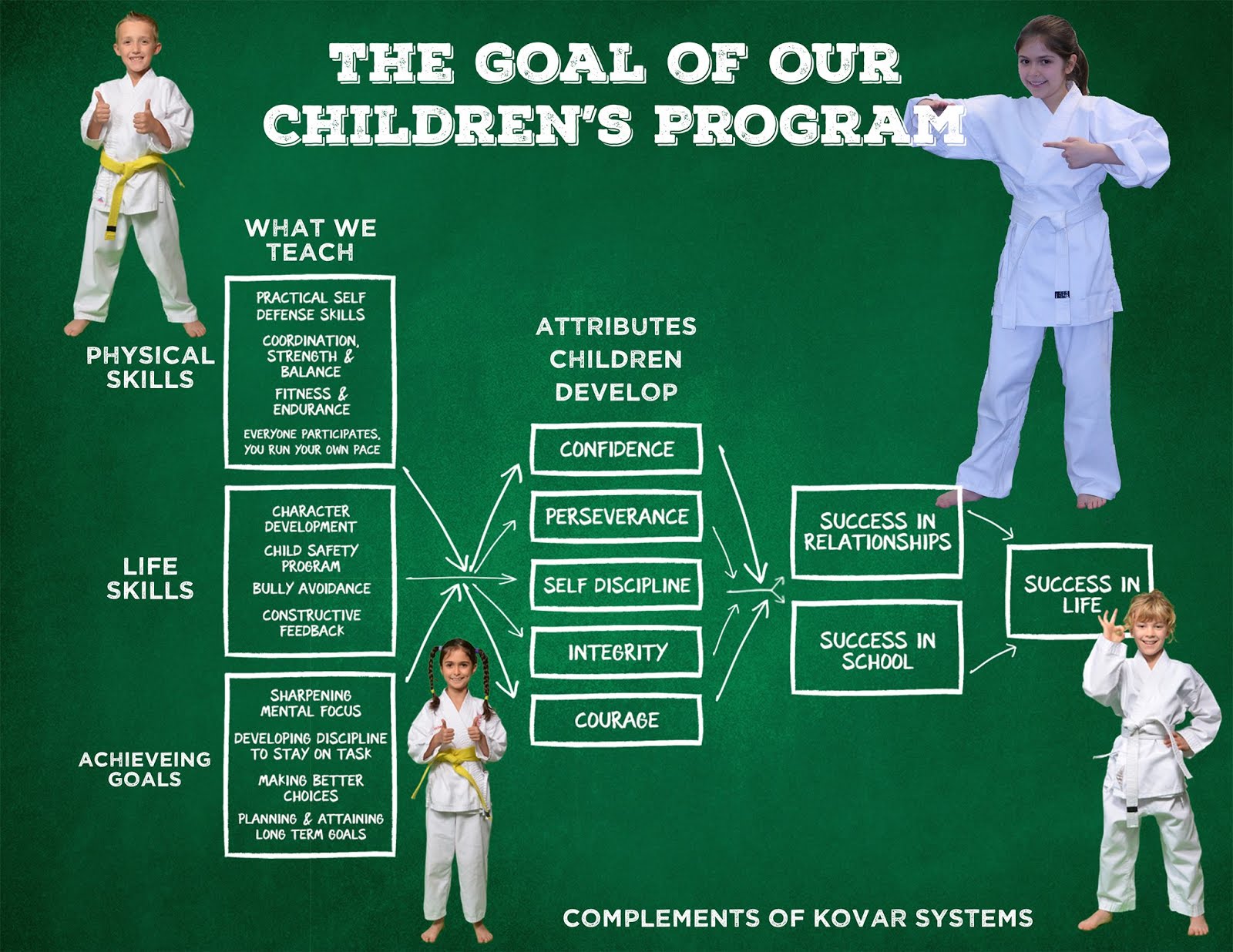


It is easy to say our program achieves these objectives, but what is the proof that makes us different than other martial arts school in your area?

Develop Life Skills

  • Monthly Warrior Challenges - One way your kids will achieve these skills is through monthly Warrior Challenges. For example, this month (June) is Fitness. By completing this warrior challenge your kids will develop a lifelong attitude to good health, but they will also develop the discipline to complete the task and dedication by sticking to a goal.
  • Mat Chats - Another way your kids will develop these skills is through Mat Chats. These are short 3-5 minute discussions about our Martial Arts Principles and Values, such as discipline, respect, confidence, focus, integrity, and self-control. During these chats, your kids will learn ways to apply the life skill at home, school, and work.  We will also discuss how to use these skills in social situations, family interaction, and, of course, in the martial arts classroom.
  • Bully Situations - Your kids will first develop self-defense skills and then will develop the "cool" martial arts skills. Self-defense is our first priority and focus. This is the reverse of many martial arts schools that teach this in reverse and have students who can't really defend themselves until they are black belts or beyond. Your kids will learn how to deal with "bully" and "bad guy" scenarios from day one. Your kids will learn how to deal with a bully without having to create a physical altercation, but if needed they will have the skills to defend themselves against a physical attack. Your kids will learn a variety of skills from stand-up defense and ground defense.  They will learn skills to defend an attack without kicking and punching through wrestling and grappling, but they will have strong striking skills to use if needed against a "bad guy."

Achieving Goals

  • Sharpen Mental Focus - Goals don't have to be things that take your kids weeks, months, or years to achieve.  Goals can be simple. We teach your kids to break down a larger goal into smaller goals to make the larger goal easier to achieve. For example, one of our students has ADHD and is working on improving his focus. We consistently work with him and his parents to find ways to give him tools to help improve his focus. It may take years before his focus is equivalent to a student without ADHD. If we compare him to other students and set a goal to this standard, it would not be fair to him or the other students.  Instead, we set micro goals to help him learn to control his focus. We have found music is one way that helps him, so we turn on a very rhythmic beat in class to help direct his attention. He also has done amazing when asked to balance on a bosu ball and do kicks and punches. This requires hyper focus on this balance and allows him to filter out other distractions and concentrate on the task at hand.
  • Developing Discipline to Stay on a Task - There are many tools we use to teach your kids self-discipline. Each belt and level have specific requirements and skills that must be learned and practiced. Many times there are "Warrior Challenges" (see explanation above) that must be completed in order to earn the next belt. These requirements are always manageable and appropriate for the age of the student.  By meeting these requirements, your kids learn how to set goals and develop the discipline to complete tasks towards a goal.  Some tasks are more simple than others. Some may require a few days where others will require a few weeks of work to achieve, which will help your kids "develop the self-discipline to stay on a task."
  • Shaping a Generation of Leaders - Ultimately, our goal for your child is not for them to achieve black belt, but to develop the skills to be successful in life.  The path to black belt is a tool to help develop these life skills. Through the steps to black belt, your child will learn how to "plan and obtain long-term goals."   Here is what one parent said about our approach. "We just wanted to thank you for your martial arts approach and philosophy of ‘creating a generation of Leaders’.  [Our daughter] was one of 25 students that got invited to interview for the highest [college] scholarship awards. All three scholarships are looking for ‘leaders’."  -Parent of two Black Belt Students.  There daughter went on to be awarded this college scholarship.


Physical Skills

  • Practical Self Defense Skills - Developing self-defense skills is the priority in our physical skill curriculum. Your kids will walk out of every class with one more self defense skill in their tool box. Unlike many martial arts programs, our curriculum is constantly evolving, so that your kids will learn the most practical self-defense skills from modern martial arts.  (See "Bully Situations" above for a description of skills your kids will learn).

  • Coordination, Strength, & Balance - Your kids will naturally develop these physical skills in their classes. We tailor activities to develop these skills to your kid's abilities and age.  Younger students primarily develop these skills through balancing on our beam, crawling through the tunnel, and playing games that encourage running, jumping, stepping, balancing, and wrestling with parents. Your older kids will develop these skills through more advanced games and activities as well as through the practice of martial arts skills like kicking, blocking, and grappling.   


These are just a few samples of ways we will help your kids develop Physical and Life Skills and help them Achieve their Goals. With a Master's Degree in Education, you can believe that we have the knowledge and skills to help your kids blossom.

Thank you, Kovar Systems for developing this poster and Mr. Fariborz Azhakh for sharing.

Thursday, March 9, 2017

Learning Struggles - I get it.

I struggle learning? I struggled learning how to read and spell in elementary school. I struggled learning how to land an airplane (but after much study and practice, I finally got it). As an airline pilot, I struggled learning systems of new airplanes and would have to study longer and harder than everyone in my class. I struggled to enjoy sparring as a young Orange Belt new to sparring in karate. And now I am struggling to learn more advanced Jujitsu skills.

Sometimes I wonder if my learning struggles are a result of my learning characteristics or my teacher's failure to teach effectively. Or maybe a little of both. I know I learn slightly different than the majority. As I reflect, I realize I definitely pick and choose my instructors whenever I can. If an instructor fails to be able to modify, adapt to a learner, or teach multiple ways, then I struggle. When my own money is paying for that instructor, then I find an instructor that works for me. In the past when I haven't had the chance to choose my instructor than I have dug deep and used the martial arts principle of Perseverance (or was it me being stubborn). Either way, maybe this is why Perseverance is my favorite principle.

I could go on about my learning struggles for a long time, but instead, let me tell you that I get it.

I GET IT if you struggle to learn.

I GET that not everyone learns the same.

I GET that as an instructor I can't just teach one size fits all.

I GET that I need to tailor my teaching style for you.


Maybe all my struggles in learning are the reason why I imaged I would be a teacher when I was a young kid.

Maybe that is why I completed the process to become a Certified Martial Arts Instructor (under ACMA).

Maybe that is why I became a Certified Master Aviation Instructor (CFI, CFII, MEI, AGI, MCFI).

Maybe that is why I went to school to learn about teaching and completed my Master's Degree in Education (M.Ed).

If you are struggling to learn in one of my classes that I am teaching, please let me know. I will take the time to figure out how you learn best.

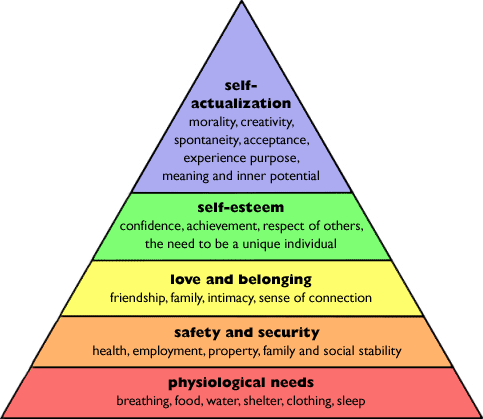
Image result for maslow's pyramid
Here are some links about learning styles:

Wednesday, February 22, 2017

Devloping The 3-C's: Courage, Confidence, and Composure

"Dad, my stomach hurts."

Butterflies get us all.  Yes kiddos, even adults get butterflies. Isn't it cool that you and your kids get to learn to deal with nervous butterflies as a student of the martial arts, and you don't have to wait until adulthood to deal with these feelings?

Flight or Flight is a natural response to stress.  Check out this video to see why we have this natural response.


Image result for karate demoYes, I purposely create events that generate elevated levels of stress to help students learn to deal with positive stress in a safe, fun environment. Our events like our Level Promotion Ceremonies, Games and Demo events are all safe events I design to develop the life skills of Courage, Confidence, and Composure (aka - the 3-C's). 
Don't worry, as a M.Ed (Master in Education), I know how to encourage your kids to push just a bit more than they would push themselves. But I am very careful not to over stress a student to the breaking point. This is what is great about our "Family Academy" environment. Our school is just the right size, where I know you and your kids well, and can create an event that is designed just right for their current skills level. Schools with 100+ students and a "Master" who only performs Belt Exams or teaches just the "senior" students, can't create this effective learning environment designed perfectly for you.

And you can be assured that if I am encouraging you to work on the 3-C's, I will ask myself to do the same. So when I ask you to perform at a big event, I will perform as well (when appropriate). Yes, I get nervous performing in front of people too, even after 24+ years of martial arts training. But, without learning how to overcome the Flight or Flight response at a young age (I started martial arts at the age of 11), I would never have been able to become an Airline Pilot. Trust me, being a female Airline Pilot and FFDO (Federal Flight Deck Officer) demands performance in many stressful situations. And you can bet, I borrow from these experiences and others, to create a safe, fun, and slightly stressful event that will help you (and your kid) succeed in life.

Remember our Moto - "The Journey is the Award" and know that we are "Shaping a Generation of Leaders."

Keep Flighting,

Sifu S

Sunday, January 29, 2017

Practicing Martial Arts with Your Kids

Your kids come home from Martial Arts class and want you to help them practice, but you don't know where to start.  You have never taken a martial arts class, and you don't know what to do.  Let me give you some ideas.

Rule #1 - Keep it Fun!
First, the most important thing to remember is to keep practice fun and positive.  I can tell you, after teaching martial arts for over 20 years, that the fastest path to quitting martial arts (or any other activity, for that matter) is putting too much pressure on your kids. If you are constantly nagging at them and not keeping it fun, they will not want to practice. Martial arts provides more life skills than any other sport or extracurricular activity, so the last thing you want is your child disliking it and giving up.  Always keep it positive and fun!

Follow your Kid's Lead
Image result for practice karate with parentIf you kids want to practice with you, this is a good thing, so practice with them. Ask your kids how and what they want to practice.  Follow their lead and desires.  If you son wants to just practice kicks today, let him.  If you daughter wants to practice jumping, spinning, and a bunch of crazy Kung Fu Panda moves that you can't decipher, encourage her. Any practice is good practice.  Encourage your kids to practice certain things, but don't force them. "John, let's practice your blocks." "Sally, let's go through your self defense techniques."  If they say, I don't want to, ask what they want to practice. Any practice is better than no practice.


Short Impromptu Practice is Great
Image result for practice karate with parentGrab your kids in a self defense technique in the kitchen, and let them put you on the floor.  Wrestle during commercial breaks in the living room.  Play spar in the hallway.  This type of practice can be the best practice and makes for great bonding moments.  

How long and often should my kids practice?
My opinion is, as long as your kids want, and as long as it stays positive and fun. I ask my students to practice at least once per week, but I rarely give a time limit. Encourage them to practice, keep it fun, and they will want to do it. When they are truly ready to end the practice, whether it has been 5 minutes or 20 minutes, then wrap it up.  End on a fun note, so that they want to practice next time. Also, remember that there needs to be a balance, so they don't burn out. Give your kids opportunities to practice with you and by themselves. Also, make sure they have plenty of other opportunities to play with their friends, do other sports, and be involved in other activities, and this will make them want to keep attending the real life skill builder - martial arts.

Be the best training partner
Image result for practice karate with parentBe your kids' favorite training partner, not their Sifu or Sensei. Throw punches and be their "bad guy" so they can practice their techniques. Be their grappling buddy. Hold the mitts and be their boxing partner. Let them be the teacher and let them teach you. Constantly praise them for what they are doing. Don't worry about what they are not doing right. Focus on what they are doing well, and tell them. "John, that was a great, high kick. You are getting so good." Who cares if John's hands were down and he wasn't protecting his face. Next time you catch John with his hands up, praise his for that.

For beginning students, simply just encourage and help them practice. No need to challenge or push them; remembering the skills are a challenge enough. As your kids progress to the intermediate and advanced levels, your training partner skills might need to increase. Help your kids work on power, speed, or agility. Get them to hit the mitts a little harder or faster. Hold those grab attacks a little tighter, but only one step above their current ability. It is okay for them to be challenged, but constant failure will quickly drive them away from the martial arts, so allow them to win sometimes too. Help them improve, keep it fun, and create some challenge that they can overcome.  

Practicing Techniques
Be your student's "practice dummy" which is also known as an "uke" in the martial arts.  Learn how to grab them, how to attack during ground techniques, and which punches and kicks to throw. When being an uke, watch out for kicks and strikes that could hurt you. Yes, I have seen 5 year olds give instructors bloody noses and make them drop to their knees from a kick.  Remember, they are still learning coordination and self-control. Let your kids make light contact if you feel comfortable, but until they get more self-control, watch out. As you kids become more advanced, you may want to consider wearing some protective gear, like a chest guard, to help them practice. We can recommend gear and equipment to help you practice at home.

Image result for practice karate with parentPracticing Sparring Skills
Get some mitts, muay thai pads, a bag, or a sparring bag shield.  Learn the combos and how to hold the mitts. Turn on the music and have some fun. This can be a great workout for you as well as your kids.

Wrap-up
Hopefully, this gives you some ideas on how to help your kids practice.  Stop by class to get some more ideas, or better yet, join class so that you can learn with your kids.  As the old saying goes, "A family that kicks together, sticks together."

Thursday, January 5, 2017

My Favorite Martial Arts Books

Over the years I have collected a list of my favorite martial arts related books.  I hope you enjoy. Happy Reading.


Books related to Self Defense


 The Gift of Fear by Gavin de Becker

Books related to Martial Artist's Philosophy


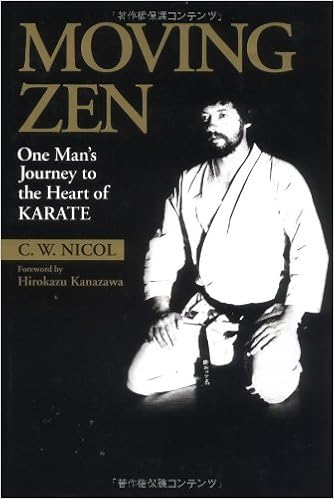
 Moving Zen: Karate as a Way to Gentleness by C.W. Nicol

The Artist's Way by Julia Cameron

The Art of Happiness by Dalai Lama


The Tao of Pooh by Benjamin Hoff

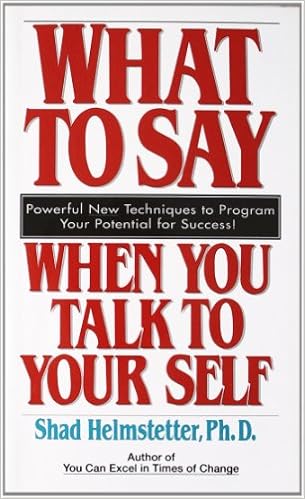
What to Say When you Talk to Yourself by Shad Helmstertter, Ph.D. 

The Seven Habits of Highly Effective Teens by Stephen R. Covey

Product Details

Everyday Tao: Living with Balance and Harmony by Ming-Dao Deng


Books related to Martial Arts Technique


Ed Parker's Infinite Insights into Kenpo (Series) by Ed Parker


Essential Anatomy: For Healing and Martial Arts by Mac Tedeschi

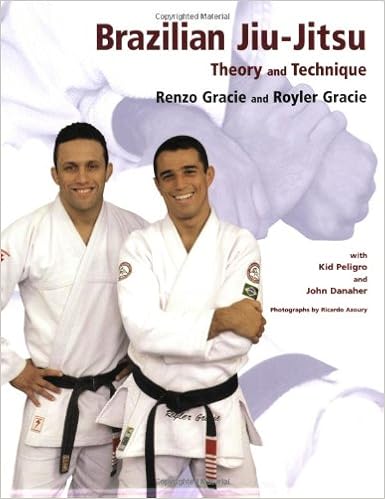
Brazilian Jiu-Jitsu: Theory and Technique by Renzo Gracie

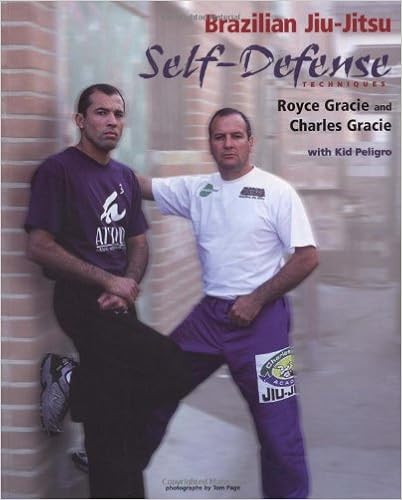
Brazillian Jiu-Jitsu Self Defense Techniques by Royce Gracie

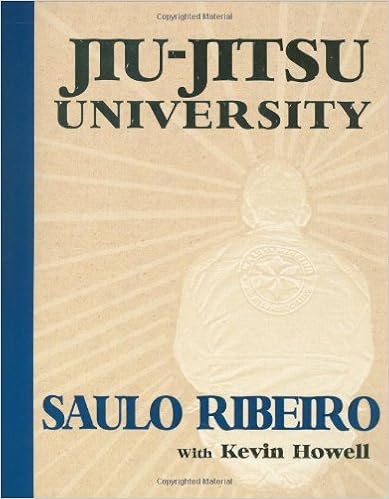
Jiu-Jitsu University by Saulo Ribeiro

The Gracie Diet by Rorion Gracie


Books related to Martial Art Sport

My Fight/Your Fight by Ronda Rousey

Open: An Autobiography by Andre Agassi

Sound Like a Good Read

I Got this. To Gold and Beyond by Laurie Hernandez

Background:
All of the books listed here, I have read and many are in my personal library.

Over the years I have been required to read several books for advancement in the Martial Arts. Some of the books I enjoyed and have found beneficial. (I have included some of those books here). Others were dry and unreasonable (they are not listed). 


Positive Teaching

[Original Article Written Nov 2015]
Earlier this week, I had the opportunity to observe another martial arts school's youth class, ages 5-13 years old.  I was appalled by what I saw. Let me explain.

As many of you have heard me say, it is more important to find a good instructor over the style of martial arts.  I tell this to a student anytime they move and have to look for a new martial arts school.  And this fact was very true for the class I was observing.  The school had a very popular franchise name with a great reputation, but what is on the outside doesn't always make the inside.  Here is what I observed and what makes Flying Tigers different and special.

At Flying Tiger Self Defense our certified instructors go through a rigorous training process that lasts at a minimum 2 years and 100+ hours. The training they receive consists of 5 levels, where the instructor must apprentice and learn from a certified instructor, learn and practice teaching skills in actual classes, and then they are evaluated on their teaching skills. Depending on the age of the student instructor it can take several years to earn one's Red Jacket and become a certified instructor. Our students are not required to become teachers to earn their black belts because not everyone has the patience and desire to teach. And our belief is, that just because you are a black belt, that does not certify you or give you the skills to teach. But for those who do want to teach at our school, they learn interpersonal skills that will last a lifetime and will transfer to an endless number of jobs and careers.

So what did this instructor do so wrong? To start with, within the first 10 minutes of class the instructor yelled at his own children no less than 10 times. His unprofessionalism was so bad, it sent chills down my spine and made me want to run to the door. As he "instructed" the class, he stood in the front of the room barking orders. Never once did he get on the student's level and help them. Remember, he was teaching kids, not adults.  And worst of all, his instructions to the kids consisted of, "No, don't do that. Don't move like that. That's stupid. No one would ever do that," and "No, no, no, no, no."  As an instructor that tries to avoid all negative verbiage while teaching, this was like hearing swear words explode out of his month. I couldn't believe parents were paying over $125/month for this class so that their children could be yelled at for an hour non-stop.  I wouldn't pay $10/month to put my child in this class.

So, how is our teaching philosophy different? First of all, our level one instructors learn and must demonstrate how to teach using positive phraseology.  This means the instructor says, "Johney, great kick.  Now just keep your hands up," instead of saying, "Johney, stop dropping your hands when you kick. You'll get hit in the face.  Stop being so stupid."  Second, we tell our instructors to treat, "no," like it's a swear word.  Why? Yes there is a time and place for the word "no," but it isn't in a learning environment.  It is a great word for safety, "Johney! No, you will burn your hand." So instead of telling our students, "No, that's wrong. Don't do that," we teach our new instructors, to tell the student what they are doing right and explain how they can make it better.  "Johney, I can tell you are working hard to learn this technique.  Now, to make it better try putting your thumb here. Great, nice job."

On the drive home from the class, my husband asked me how I would have handled the misbehaving kids in the class. I explained that kids will behave in whatever fashion gets them attention. This means that if the kids who are misbehaving are getting attention, then Johney is also going to misbehave so he can get attention. Instead, we teach our instructors to ignore the misbehaving kid and praise the behaving kid. "Johney, you are doing a great job staying on your spot today.  Nice job.  High-five."  Now Timmy who has been goofing around sees Johney getting attention and wants a high-five too, so Timmy starts to behave and stand on his spot.  So then what do we do?  Give Timmy a high-five.  This makes the environment more positive and hence more fun for all.

Now, these are just three teaching techniques we use in our classes.  There is a long list of other teaching skills we use and teach our instructors.  All-in-all this experience made me grateful for the instructors I had, who taught and certified me to teach positively.


-Sifu S
Nov 2015

Saturday, December 17, 2016

Learning Responsibility & Respect is Necessary

In addition, to teaching Martial Arts classes, I have a Master's in Education and I teach college courses part-time. I just finished submitting grades for the semester.  [Sigh]. I love teaching, but I am continually amazed by the number of students in this generation who lack respect for others and their lack of ability to take responsibility for their own actions.

Responsibility for Their own Actions:
I had several students this semester who argued over getting B+, A-, and A's. I awarded 19 A's, 16 B's, 2 C's, and 0 D's. Wow, the emails I had to write to document my work and argue grades. The B students wanted A's.  The A students wanted higher A's. More than once I bluntly said, "Not everyone can get an A+." I even told one student that if he had spent as much time on his paper as he did arguing about the grade I gave him, he would have received a higher grade in the first place. 

Lack of Respect for Others:
Many students in my classes had a total lack of general respect for fellow classmates (not to mention the instructor). They would read novels in class, surf the web, play games on cell phones, etc. And this was even after I asked them to turn off their computers and phones during classmate's presentations. They didn't care. They did it anyway. I could write a book explaining what I did and didn't do this semester to counter-act this behavior and create a great learning environment. (So please don't comment on what I should have done. Trust me I did it). 

My Take Away:
I may not be able to do anything about the current generation's behavior. I can encourage them to take responsibility and have respect for each other, but really this is something they should have been learning for the previous 20 years. The chance that my encouragement could change their behavior is minimal, but I do encourage because resigning that there is nothing I can do, is just as socially irresponsible.  

How I Help through Martial Arts:
Long story short, this is where teaching Martial Arts comes into play. If kids aren't learning responsibility and respect in Grade School (or at home), then I guess I can help society by teaching it to my Martial Arts students.  I strongly believe these are two life skills that are necessary to be successful and socially responsible in life.  

Image result for student karate bowI can promise you these are values we stress and require from all our students, from White to Black Belt. And their training in these two areas starts on day one. Students quickly learn it is their responsibility to remember to bring their belt, uniform, and gear to class. Even the 5-year-olds don't get to use Mom and Dad as scapegoats and say, "Mom, forgot it."  Some parents say, "Why bother they are just kids." Ya, well, these kids will turn out to be adults someday and they won't have the skills to function if they are not taught. You may teach these skills at home, but I guarantee we will teach them in class.

If nothing else my Martial Arts students will stand out in society as outliers and hopefully will some day be recognized for their responsibility for their own actions and respect for others.

How to Tie Your Belt

The first thing students say to me after I award them their White Belt is, "I don't know how to tie this on." "That...